
What A Lovely House, She Said Sweetly. “My Parents Get The Upstairs. My Sister And Her Kids Get The Downstairs. It’s Your Duty To Host Us.” I Stood Up, Smiled…

At a family gathering, my daughter-in-law announced plans for her family to move into my lake house without ever asking me. I stayed calm, but the moment she told me it was my duty to host them, something between us changed.
Tap LISTEN TO THE FULL STORY below to reveal the narrated video and start listening.
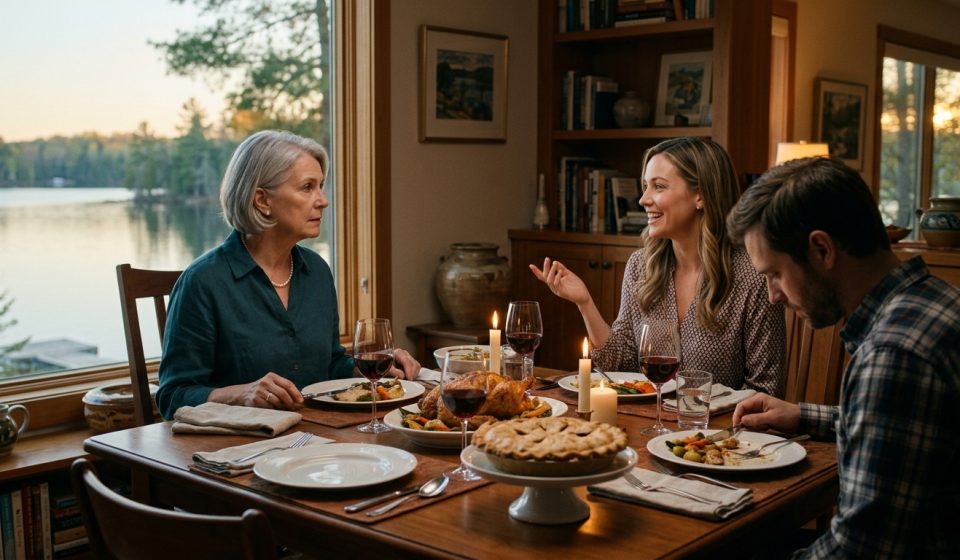
At a family gathering plans were made about my home without anyone bothering to ask me. My daughter-in-law Sierra sat at my dining table, eating the pie I’d baked that morning, and calmly announced exactly how my lake house would be divided: her parents would take the upstairs, while her sister and the children would have the downstairs. Then she looked at me as though the arrangement were perfectly reasonable and told me it was my duty to host them.
I set my fork down carefully and looked directly at her. This was my home, I reminded her—not a hostel. For a moment, the entire dining room went still. I’d spent the day preparing for their visit, lighting candles, setting out cloth napkins, and even remembering that Sierra didn’t eat strawberries. Outside, the lake was perfectly calm, while inside my own dining room, someone had just assigned rooms in my house as though I had no say in the matter.
Sierra didn’t retreat. She smiled again and explained that it would only be for a few weeks. Her family had never experienced staying at a lake house, she said, and besides, I wasn’t really using all that space. I remained quiet, not because I had nothing to say, but because I knew that once I started, I might not stop. They finished dessert as though nothing unusual had happened, while I cleared the plates alone.
🎧 Listen to the Complete Story
Press ▶ Play below to enjoy the full narrated story.
Afterward, they sat on the porch drinking coffee and discussing summer travel plans. Their laughter drifted through the screen door while I moved around the kitchen.
When they finally left, I walked slowly through my house.
I closed every window.
I checked the locks twice.
Then I turned off the lights in rooms I’d once imagined family might help fill someday.
That night, I left the porch light on. I wasn’t frightened. I simply felt alert, as though something underneath the peaceful life I’d built had suddenly shifted.
The house meant more to me than Sierra seemed to understand.
I’d spent forty years working quietly in the basement of a university library, filing manuscripts, letters, photographs, and other people’s memories. It was patient work, and I liked it. After my husband died when Evan was twelve, there had been no time for me to collapse.
I packed lunches.
I paid bills.
I kept us moving.
I never remarried. Instead, I worked more hours, moved us into a smaller apartment, bought used clothing, skipped vacations, and saved whatever I could.
When Evan needed the deposit for his first apartment, I paid it.
When he and Sierra became engaged and her mother refused to pay for the dress, I paid for that too.
I never demanded anything in return.
I didn’t want extravagant birthdays or constant gratitude. I wanted something much simpler: when the time finally came, I wanted to be left in peace.
Over many years, my savings grew.
Eventually, I found the lake house.
I drove there alone and paid for it in full with a cashier’s check I’d carried folded inside my coat pocket. The first time I opened the door and watched sunlight pour through the windows above the kitchen sink, it felt like a reward for everything I’d sacrificed.
For an entire year, that was exactly what it became.
Quiet.
Water.
Trees.
Space.
A place where nobody needed anything from me.
Then came Sierra’s smile.
And seven days after the family gathering, I looked toward my gravel driveway and saw something that made the conversation at my dining table suddenly feel much less hypothetical.
A large white moving truck was coming toward my house.