
My Dad Said The House Felt Better Before My Kids Arrived For Christmas. He Forgot I Was The One Holding The Family Together. He Said It So Casually, Too.

My dad said the house felt better before my kids arrived for Christmas, while they were still standing there holding presents they had made and desserts they had helped prepare. When I saw my eight-year-old son’s smile disappear, I realized staying quiet would teach my children the wrong lesson.
Tap LISTEN TO THE FULL STORY below to reveal the narrated video and start listening.
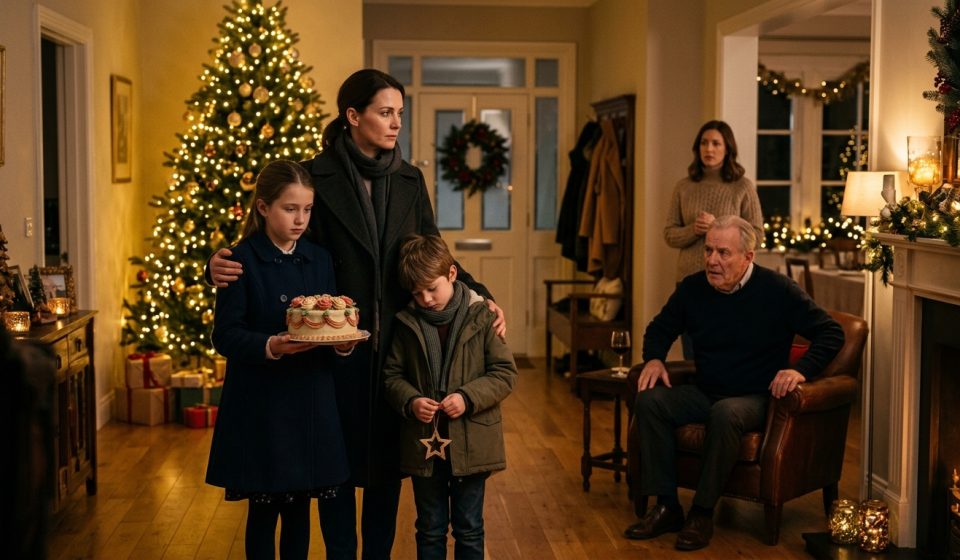
My dad said the house felt better before my kids arrived for Christmas as casually as if he were commenting on the weather. Lily and Noah were still standing in the entryway in their winter coats, carrying wrapped presents and homemade desserts. My 12-year-old daughter had spent the morning protecting the icing roses on the cake she’d baked, while my eight-year-old son had carefully held a wooden ornament he’d made for Grandpa during the entire drive. Then I looked at Noah and watched his smile disappear.
His shoulders pulled inward, and his eyes dropped toward the floor as though he’d suddenly realized he was taking up too much space. That was the moment something inside me changed. I kissed the top of his head, took the pie dish from Lily, and told Dad that if the house had felt better before we arrived, we could fix that.
Dad immediately accused me of being dramatic. I didn’t argue. I started wrapping Noah’s scarf back around his neck and told the kids to gather their things. From the dining room, my younger sister Rachel nervously insisted Dad hadn’t meant his comment “like that.” I asked her one simple question: Then how did he mean it?
🎧 Listen to the Complete Story
Press ▶ Play below to enjoy the full narrated story.
Nobody answered.
That silence told me everything.
My family had spent years learning how to translate Dad’s behavior.
There were always little cuts disguised as humor. If someone became hurt, they were too sensitive. If they answered back, they were disrespectful. If they cried, they were creating trouble.
And somehow, I was always expected to make everything okay afterward.
I was the person who brought gifts when Dad forgot them.
I called Rachel when she stopped answering everyone’s messages. I checked on Aunt Denise when her arthritis became painful and reminded my brother Mark to pick up Grandma’s medication.
I made sure there was enough food, enough chairs, enough patience, and enough peace.
That Christmas was no different.
I’d stayed up late helping Lily wrap presents, gotten up early to prepare half the Christmas dinner, and driven everything across town.
I was the bridge holding everyone together.
And bridges get stepped on so often that eventually people forget they’re carrying any weight at all.
Lily quietly asked if we were really leaving.
I could see the question in her face.
She already understood that we should leave. What she needed to know was whether I would actually do it.
Children notice the difference between what parents tell them and what parents tolerate.
I couldn’t tell Lily and Noah they deserved respect while keeping them inside a house where someone had just made them feel unwanted.
So I told Lily yes.
Get your things.
Dad stood up.
Again, he insisted that I was being dramatic and claimed his comment had only been a joke.
This time, I looked directly at him.
“Who laughed?”
For half a second, he had nothing to say.
Then he doubled down.
He complained that the house had been quiet and orderly before we arrived and that now everything had become chaotic.
My brother Mark had just walked inside carrying firewood. He stopped in the doorway, immediately realizing he’d entered the middle of something serious.
Then I saw Noah.
He was clutching the little wooden ornament he’d made for Grandpa so tightly in his gloved hand that I thought it might break.
That was enough.
I reached for my coat.
Dad’s voice changed when he realized I wasn’t bluffing. He asked what I thought I was doing.
I told him exactly what I should have done years earlier:
I was showing my children that they never had to stay somewhere they were merely tolerated instead of welcomed.
Rachel begged me not to do this on Christmas.
But Christmas was precisely why I had to.
Because if the house felt better before my kids arrived, I wasn’t going to force them to stay another minute just to preserve everyone else’s idea of a peaceful holiday.
Then Dad looked at me and asked the question that finally exposed how differently we understood what had just happened:
Would I really walk out over one sentence?