
After My Millionaire Grandfather Died And Left Me Everything, The Parents Who Ignored Me My Whole Life Dragged Me To Court For The Inheritance.

My parents dragged me to court over the inheritance my millionaire grandfather left behind, even though they had barely been part of my life for years. I was served just 40 minutes after we buried him—and the way my mother reacted made it clear this fight had already become deeply personal.
Tap LISTEN TO THE FULL STORY below to reveal the narrated video and start listening.
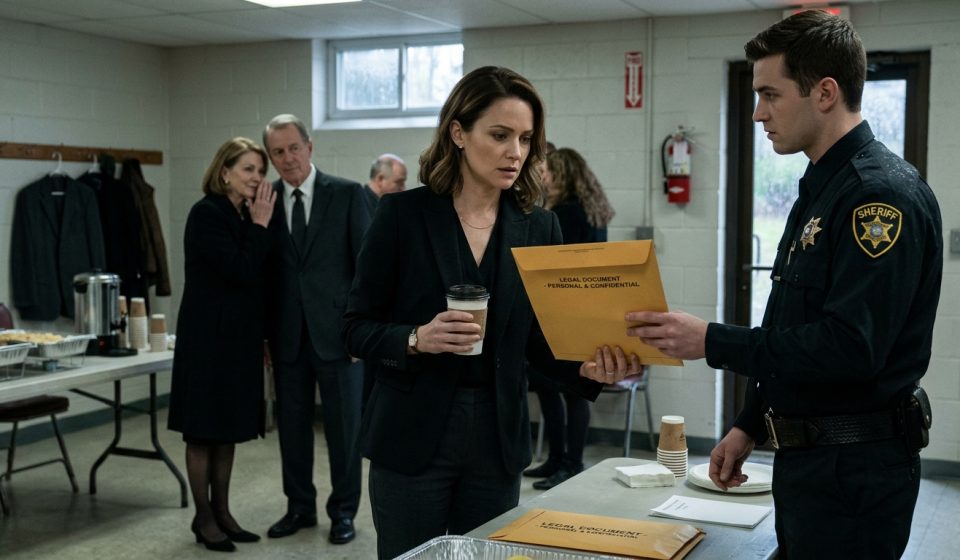
My parents dragged me to court over my millionaire grandfather’s inheritance after spending most of my life barely noticing me. The first sign of what was coming arrived just 40 minutes after we buried him, when a deputy approached me in the church basement while I was still holding a paper cup of cold coffee and apologetically handed me an envelope bearing my name.
My mother stood only 11 feet away holding a plate of ham. She had flown in from New Jersey that morning, dressed in a black coat I had never seen before, and spent the funeral crying loudly. She watched the deputy give me the envelope. She watched me read the caption. Then she leaned toward my father, whispered something behind her hand, and they laughed.
As she walked past me toward the coat rack, close enough for me to smell her perfume over the coffee, she delivered one sentence without even turning her head: “You always thought you were better than us.” Sixteen days later, those same papers would be read in a Hartford courtroom—but understanding why they mattered meant understanding the man my parents had stopped bothering to know.
🎧 Listen to the Complete Story
Press ▶ Play below to enjoy the full narrated story.
My grandfather, Walter Bennett, was 82 when he died. For 11 years, I had driven to Connecticut every third weekend to visit him. Only three weeks before his death, he’d insisted on cooking his own birthday dinner: the same pot roast he’d been making since 1974.
Grandpa had built Bennett Precision Components from a six-person machine shop in 1981. Over the years, it grew into a regional supplier employing 74 people. Despite his success, he never abandoned the house he’d bought in 1977 or his old Accord with the cracked cup holder.
More importantly, he kept everything.
His basement was lined from floor to ceiling with copier-paper boxes, each carefully labeled in block capitals. Taxes. Supplier correspondence. Insurance. Grandpa even kept a permanent marker tied to a string near the stairs so nobody could lose it.
When I was 15, I used to tease him while he alphabetized receipts.
His response stayed with me.
“Paper remembers what people decide to forget.”
At the time, I thought it was simply an old man’s obsession.
Years later, I would understand it differently.
My parents had stopped visiting Grandpa around the time I turned 21. My father, Richard, repeatedly approached him for money—first for a restaurant, then a boat dealership, and later for something involving vending machines. After Grandpa refused for the third time, their visits gradually disappeared.
Their relationship with me faded differently.
My mother, Diane, treated attention like a reward. If I was useful, impressive, or convenient, she noticed me. Otherwise, she returned to her own life.
My parents missed my law school graduation because they attended a wedding in Delaware. They didn’t come to my swearing-in ceremony. When I eventually made partner, I called them with the news.
Four days later, Dad replied with a thumbs-up emoji.
So I stopped telling them things.
By 36, I had become a partner at a forensic litigation firm in New York. My work involved following money people desperately wanted to hide—shell entities, fraudulent transfers, manipulated trusts, and forged signatures. I’d served as lead forensic counsel in a major federal case and testified before a state banking committee.
My parents knew almost none of it.
As far as they understood, I did “something with contracts.”
Grandpa was different.
He knew what I did. He remembered the names of opposing counsel and asked what I was reading. When I lost my first major case, he drove two hours to Manhattan simply to have dinner with me.
And now, immediately after his funeral, my parents dragged me to court over what he had left behind.
They thought they knew exactly who they were fighting.
But after all those years of barely knowing me—or Grandpa—they had no idea how much they had never bothered to learn.