
On The Day My Husband Passed Away, I Said Nothing About The $28 Million Inheritance – Or About The Skyscraper In New York City Under My Name. That Same Night…

My daughter-in-law threw me out only hours after my husband died, while my son stood behind her and said nothing. She expected me to beg for somewhere to stay, but when I quietly said “Okay,” she had no idea what she had just set in motion.
Tap LISTEN TO THE FULL STORY below to reveal the narrated video and start listening.
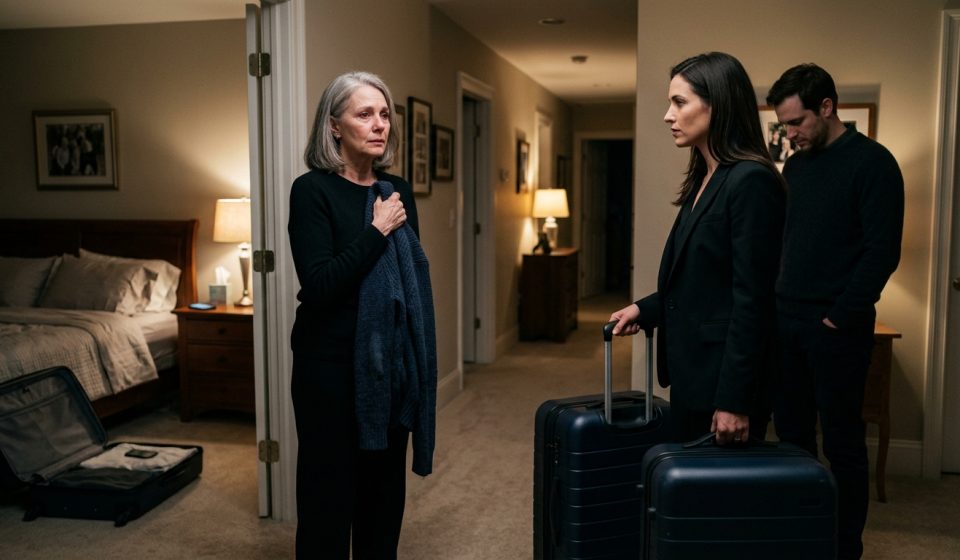
My daughter-in-law threw me out on the same day my husband died. Daniel had been gone for less than six hours when Brooke appeared in the doorway carrying two suitcases she’d pulled from my closet. I was still holding the cardigan my husband had worn that morning, and the bed where he’d spent his final months was still warm. Yet Brooke had already decided it was time for me to leave.
“My mother is coming tomorrow,” Brooke told me. “She’ll need this room.” My son Caleb stood behind his wife staring at the carpet. Daniel and I had moved into their home near White Plains because his cancer center was only fifteen minutes away. We paid for our groceries, his home nurse, and every medical expense, but Brooke had spent months telling people she was supporting us.
I looked at Caleb and reminded him that his father had died that day. I wasn’t asking to remain indefinitely. I was asking for one night. But Brooke answered for him, saying grief didn’t erase boundaries. Then I reached for Daniel’s phone on the bedside table—and she grabbed it before I could, claiming it belonged with his estate papers.
🎧 Listen to the Complete Story
Press ▶ Play below to enjoy the full narrated story.
Then Brooke shouted at me to pack my bags.
“The old leech doesn’t stay here.”
Caleb whispered his wife’s name, but he didn’t tell her to stop.
I looked at the son I’d raised and then at the woman gripping my dead husband’s phone. I expected anger to consume me, but what I felt was different. Anger would at least have given me something solid to stand on. Instead, it felt as though the floor beneath my entire life had disappeared.
So I said one word.
“Okay.”
Brooke blinked.
She seemed prepared for tears, bargaining, or perhaps an emotional scene she could later use as evidence that grief had made me unstable. My calm response gave her none of those things.
I packed one suitcase.
I took Daniel’s wedding ring, his cardigan, my medication, and the folder the hospice nurse had handed me. I left the family photographs behind because I couldn’t bear to choose between them while Brooke watched.
At the front door, Caleb finally touched my arm and asked where I would go.
“Somewhere I am allowed to stay.”
Brooke laughed and warned me not to expect them to pay for it.
Forty minutes later, I arrived in Manhattan.
Luis, the night security supervisor at Alder Tower, unlocked a private apartment on the building’s 37th floor. He’d worked for me for eleven years. Seeing my black dress, he asked no questions. He simply prepared fresh sheets and left a kettle outside the door.
Alder Tower wasn’t some random place I’d found after being forced from my son’s home.
It was a glass-and-limestone skyscraper my property company had rebuilt from the frame up.
I controlled it.
Caleb knew I managed some family real estate, but he’d never bothered asking what that actually meant. Brooke apparently assumed it meant a handful of old storefronts.
And there was something else they didn’t know.
Inside the hospice folder was a sealed notice from Daniel’s investment firm. His transfer-on-death account, worth a little over $28 million, named me as its sole beneficiary.
Daniel had told me about it years earlier. He had specifically asked me not to allow money to turn his final days into a negotiation, so I’d kept quiet.
I wasn’t testing anyone.
My husband had been dying, and I refused to let his bank balance become more important than the man himself.
At dawn, after a sleepless night in the private apartment, I called Naomi Price, general counsel for my property company. I intended only to tell her Daniel had died and that I needed some time away.
Naomi expressed her condolences.
Then her voice changed.
There was one business deadline she couldn’t move without my approval.
Alder Tower was choosing an operator for its new food hall, conference events, and tenant catering. I told her to allow the independent committee to proceed normally.
But Naomi said there was a family disclosure issue.
One of the finalists was a company called TableLine Collective.
Its principal was Brooke Cross—the same daughter-in-law who had thrown me out hours earlier.
And suddenly, the night Brooke forced me from her house began to look very different.