
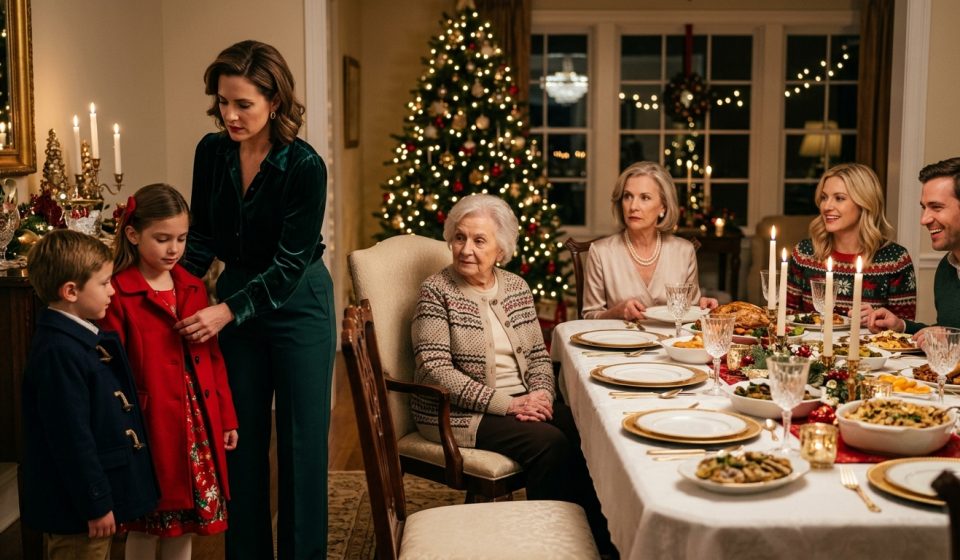
My Mother Took Christmas Dinner From My Children And Gave It To My Sister’s Girls, Saying, “They Can Eat Whatever’s Left.”

My mother took Christmas dinner from my children and handed their full plates to my sister’s girls, telling us they could eat whatever was left. When my six-year-old looked at the empty space in front of him and asked if he’d done something bad, I knew I couldn’t keep pretending this was normal.
Tap LISTEN TO THE FULL STORY below to reveal the narrated video and start listening.
My mother took Christmas dinner from my children and gave it to my sister’s girls, telling us they could eat whatever was left. My nine-year-old daughter Lily already had her fork in her hand. My six-year-old son Marcus watched his entire plate travel across the table and land beside his cousins, who already had food. For several seconds, he stared at the empty space in front of him. Then he looked at me and quietly asked, “Mommy, did I do something bad?”
Across the table, my younger sister Vanessa laughed into her wine and said they’d survive one dinner. Nobody corrected her. Not my father. Not Vanessa’s husband. Not a single adult sitting around that Christmas table. Something inside me finally stopped making excuses for them. I stood, pulled my children’s coats from the backs of their chairs, and helped Marcus into his.
My mother immediately frowned and told me not to start. When I said we were going home, she snapped that it was Christmas and accused me of ruining it over food. But this wasn’t really about one dinner. I zipped Lily’s coat and told my mother I was ending something that should have ended years ago.
🎧 Listen to the Complete Story
Press ▶ Play below to enjoy the full narrated story.
My father stared down at his plate.
As usual.
Vanessa laughed and confidently said I’d be back.
That was what everyone in my family believed about me.
I always came back.
For most of my life, my family had called me “the strong one.” By thirty-eight, I understood that wasn’t necessarily a compliment.
In my family, being strong meant being expected to tolerate whatever everyone else was protected from.
Vanessa was three years younger than me, and the pattern had started when we were children. If one piece of cake remained and Vanessa wanted it, Mom told me to be a good big sister.
If I wanted it, I was selfish.
When Vanessa needed money, she was struggling.
When I needed help, I was irresponsible.
When she cried, people comforted her.
When I cried, someone reminded me how capable I was.
Eventually, I stopped crying where they could see me.
The pattern followed us into adulthood.
Vanessa married Eric and had two daughters, Sophie and Ava, close in age to Lily and Marcus. My mother adored them openly. She bought them better birthday presents, reserved places beside herself for them during holidays, and constantly made excuses for Vanessa.
My children noticed.
Of course they did.
Children recognize unfairness long before adults are willing to admit it exists.
For too long, I’d convinced myself Lily and Marcus were too young to take the favoritism personally.
That Christmas proved how wrong I was.
Three years earlier, my husband Daniel had died in a highway accident. Lily had been six. Marcus was only three.
One day, I had another adult beside me helping hold our life together.
The next day, I didn’t.
My mother attended Daniel’s funeral and cried in front of relatives. Six days later, she stood in my kitchen and told me I’d be fine because I’d always been independent.
Then she explained why she couldn’t help much.
Vanessa had a newborn.
Vanessa needed the family.
I remember looking at my mother and thinking one question I couldn’t bring myself to say aloud:
What am I?
But one person did stay.
My grandmother Evelyn—Grandma Evie—packed a suitcase and moved into my house for six weeks.
She never told me to be strong.
When I couldn’t sleep, she sat with me.
When I cried while folding Daniel’s clothes, she didn’t tell me to move on.
She simply stayed beside me.
Two years later, after a fall made it difficult for Grandma Evie to continue living alone, she moved into my parents’ house.
My mother told everyone she had become Grandma’s caregiver.
But the reality was very different.
And as I drove away from Christmas dinner after my mother took Christmas dinner from my children, I still didn’t realize that Grandma Evie had been watching everything too—or what that Christmas night had finally convinced her to do.